

Key Takeaways
- Quantum patent activity is accelerating. U.S. quantum-related published applications grew from roughly 550 in 2020 to more than 1,400 in 2025, and 2026 is on pace for another record.
- No single company dominates. The top 15 applicants account for only about 37% of publications over the last five years. Google has overtaken IBM in annual publications, and banks now rank among the top filers.
- Section 101 is still the main hurdle, and the claims decide it. Two recent PTAB appeals of quantum-algorithm claims under § 101 came out opposite ways. One reversed the rejection and one affirmed it. In both, what mattered was whether the claims, not just the specification, reflected the technical improvement.
- Recent USPTO guidance gives applicants new tools. The precedential Ex parte Desjardins decision, the December 2025 MPEP updates, and Subject Matter Eligibility Declarations (SMEDs) all favor applicants who claim real technical improvements. The application has to be drafted to take advantage of them.
- Today’s applications are tomorrow’s enforcement assets. As the field commercializes, expect more validity challenges and litigation. Claims drafted now should be built to survive them.
Introduction
Quantum technologies are rapidly expanding in scale, complexity, and applications, and they present myriad opportunities for businesses to invest in the present and the future. Alongside that investment comes IP portfolio strategy, assessing factors such as the patentability of new technology or how to best position an IP portfolio for both offensive and defensive protection from competitors within the context of the overall industry.
Whether it be quantum computing, sensing, communication, or other industries developing in the quantum realm, an evolving competition landscape requires a dynamic IP strategy to maintain a competitive advantage as the field matures.
This article provides an overview of quantum technologies, patenting trends at the U.S. Patent and Trademark Office, and patent-eligibility challenges before the Patent Trial and Appeal Board. The industry has rapidly expanded over the last decade, and the number of patent publications each year continues to steadily climb. Large players such as IBM or Google have led the number of patent filings, but quantum-focused companies such as IonQ or Quantinuum have mirrored the increasing pace. While the number of publications each year continues to trend upwards, subject matter eligibility rejections for quantum technologies at the USPTO are evolving as agency policy is updated, highlighting the need for a well-crafted patent portfolio with specifications, claims, and declarations cohesively drafted to avoid such hurdles.
The Wide Range of Quantum Technologies
The quantum realm encompasses core technologies in communication, sensing, and computing.
Quantum communication, in some embodiments, exploits entanglement (and, increasingly, quantum memories and photonic interconnects) to link two or more nodes in a network, enabling secure key distribution, distributed sensing, or the modular connection of separate quantum processors.
Quantum sensing uses quantum properties of light, atoms, or spins (such as superposition and entanglement) to enhance the precision of sensors that detect magnetic fields, gravity, time, acceleration, or biological signals beyond classical limits.
Quantum computing harnesses the same underlying principles to perform complex mathematical operations on qubits, with current systems built on a range of physical platforms, including superconducting circuits, trapped ions, neutral atoms, photonics, and semiconductor spins. Each platform trades off gate speed, fidelity, connectivity, and scalability differently, and the field is increasingly focused on error-corrected logical qubits rather than raw physical qubit counts.
The hardware and software stack makes advancement in these core quantum technologies possible, including hybridization of quantum and classical systems, scalable manufacturing and foundry integration of quantum components, cryogenic and laser control systems, and the error-correction codes and decoders needed to manage quantum noise. Across computing, communication, and sensing, the quantum technological realm remains full of opportunity as these pieces continue to advance in parallel.
Patenting Trends at the U.S. Patent and Trademark Office (USPTO)
The increase in quantum applications speaks strongly towards the vitality and investment in this technological field.
The following charts were prepared to visualize the landscape of published quantum-related applications in the United States over the last five years, with a particular focus on emergent fields within quantum communication, sensing, and computing1.
As shown in Figure 1, the number of quantum-related published applications has continued to climb over the last five years. Figure 2 puts this in perspective by providing the timeline of publications from 2001 to the present, which shows a spike in patent publications that began in the late 2010s which has yet to begin leveling off.
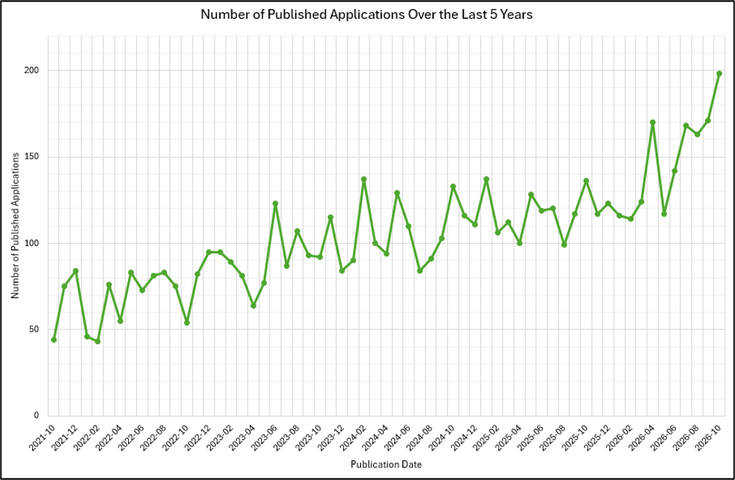
Figure 1. Total number of monthly published applications from October 2021 through October 2026 (by publication date).
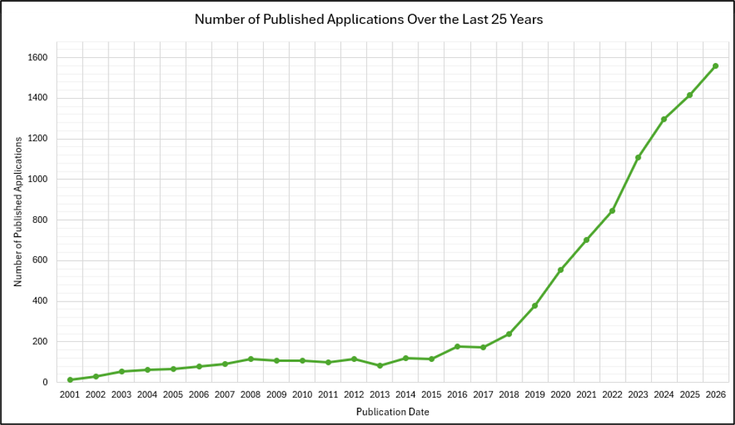
Figure 2. Total number of published applications from 2001 through October 2026 (by publication date). Even with 2026 not yet over at the time this figure was made, the year is on track to continue the upwards trend in publications.
Notably, the top 15 applicants account for around 37% of the total number of published applications over the last five years. Figure 3 shows the top 15 applicants’ share of that 37%, and Figure 4 shows a timeline of published applications for the top 5 applicants.
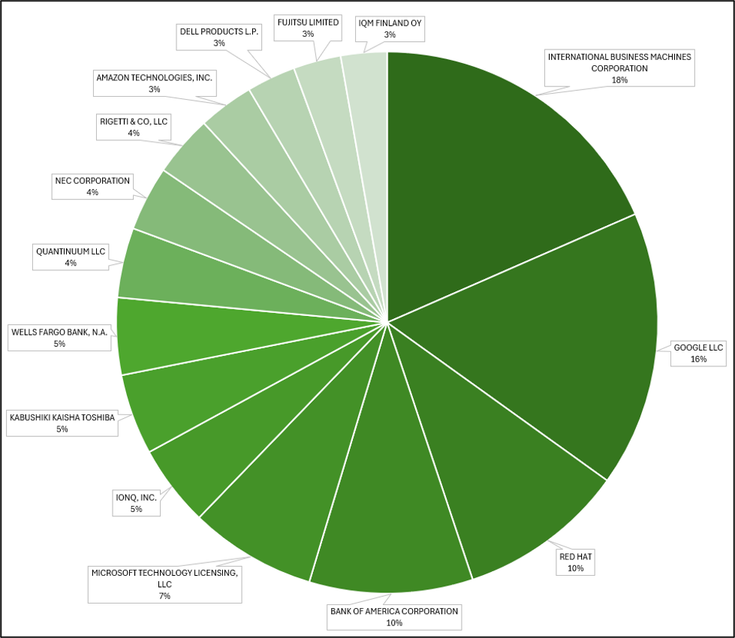
Figure 3. The top 15 applicants from October 2021 through October 2026 (by publication date). These 15 applicants altogether contributed approximately 37% of the total number of published applications over the last five years, and their respective share of that 37% is reflected in the chart.
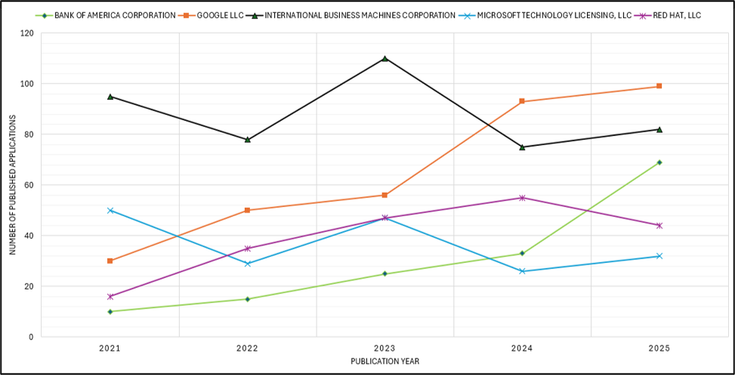
Figure 4. Total number of published applications from the top 5 applicants (IBM, Google, Red Hat (a subsidiary of IBM), Bank of America, and Microsoft) from 2021 to 2025 (by publication date). IBM remains in the lead for overall published applications, but Google has recently surpassed IBM in publications per year.
Figure 5 shows a similar timeline of published applications for a few exemplary companies that, while not as large as IBM or Google, are very prominent in the quantum field. These companies include IonQ, Quantinuum, Rigetti & Co., PsiQuantum, and Xanadu Quantum Technologies. While the overall number of applications is lower than those shown in Figure 4, these companies have generally demonstrated an increasing pace.
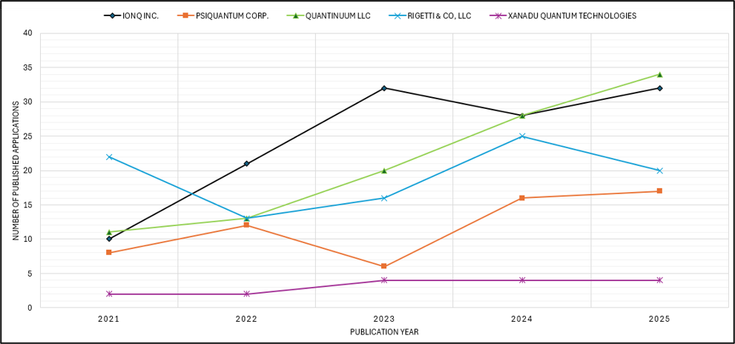
Figure 5. Total number of published applications from a selection of five quantum-focused companies (IonQ, Quantinuum, Rigetti & Co., PsiQuantum, and Xanadu Quantum Technologies) from 2021 to 2025 (by publication date).
Finally, of the approximately 6,350 published patent applications from October 2021 to October 2026 identified in this search for emergent quantum technologies, 63% belong to a family of patents with more than one published application in the U.S. While most of these families only contain one or two other applications, 6% belong to families with 5+ published applications in the U.S. and 0.9% belong to families with 10+ published applications in the U.S. This insight speaks to the growth of the industry, with applicants filing to protect a wider range of inventions rather than creating patent thickets through many overlapping applications in the same family.
The Complications of Patentability in the Quantum Realm
Subject Matter Eligibility
Following the Supreme Court’s guidance in Alice Corp. v. CLS Bank Int’l, 573 U.S. 208 (2014) and Mayo Collaborative Servs. v. Prometheus Labs., Inc., 566 U.S. 66 (2012), the USPTO has crafted a multi-step process to determine if a claim verges too far towards being an unpatentable abstract idea. The PTAB has evaluated a variety of quantum-related cases using that multi-step process.
The process can be summarized in a few steps:
cess can be summarized in a few steps:
- Is the claim to a process, machine, manufacture, or composition of matter? (“Step 1”);
- Does the claim recite an abstract idea (“Step 2A, Prong 1”);
- If the answer to prong 1 is yes, then does the claim recite additional elements that integrate the abstract idea into a practical application of the abstract idea (“Step 2A, Prong 2”); and
- If the answer to prong 2 is no, does the claim add a specific limitation beyond the abstract idea that is not “well-understood, routine, or conventional,” or does it simply mention known activities at a high level of generality (“Step 2B”).
MPEP §§ 2106.04 and 2106.05; USPTO, 2019 Revised Patent Subject Matter Eligibility Guidance, 84 Fed. Reg. 50 (Jan. 7, 2019) at 54-56.
In one case, Ex parte Cao, the PTAB evaluated claims involving a “hybrid quantum-classical computer for solving linear systems” that received a § 101 eligibility rejection from the Examiner. No. 2024-002159, at 2-3 (P.T.A.B. Feb. 13, 2025). One element in the claims received particular attention:
“on a quantum computer, controlling a plurality of qubits, according to the set of circuit parameters θ→, to prepare a quantum state |Ψ(θ→)⟩”
Id. at 12.
The Examiner asserted that the claim “is a recitation of gathering data of a particular type or source to be used in performing the abstract idea,” but the PTAB disagreed, finding that under Step 2A, Prong 2, this element “integrates the abstract idea of mathematical relationships into a practical application of enabling noisy quantum computers, which have limited circuit depth, to practically solve linear systems—a technology improvement.” Id. Critically, the specification had discussed these issues with quantum computers and made it clear that the claims were directed at improvements to the computer for solving linear systems rather than merely using a computer. Id. at 12-13.
Contrast this with Ex parte Bocharov, which involved an application for “training of variational quantum classifiers by parametric coordinate ascent.” No. 2025-003869, at 2 (P.T.A.B. June 25, 2026). The Appellant argued that the recited methods improved the functioning of quantum computers by using “generalized rotation gates and generalized controlled rotation gates” for training and implementing variational quantum circuits. Id. at 6. The PTAB disagreed for a variety of reasons.
First, in Step 2A, Prong 1, the PTAB found that the claim recited “an abstract idea of mathematical concepts” since, for example, in the specification the Appellants recite adjustments in variational parameters, include algorithms, and represent the gates as a mathematical equation (namely, “Π6⊥ + Π6G6, where Π6 = ½ I4 ⊗ (I − Z)”). Id. at 8. “In other words, the claimed invention recites a judicially excepted abstract idea in which computers are invoked merely as a tool.” Id. at 9.
Second, in Step 2A, Prong 2, the PTAB emphasized that “to make a claim directed to a judicial exception patent-eligible, the additional element or combination of elements must do ‘more than simply stat[e] the [judicial exception] while adding the words ‘apply it.’’” Id. at 10 (citing Alice Corp. v. CLS Bank Int’l, 573 U.S. 208, 221 (2014) (quoting Mayo Collaborative Servs. v. Prometheus Labs., Inc., 566 U.S. 66, 72 (2012)). The Appellant argued that the mathematics in the claims is integrated into improving quantum computer technology rather than just applying the trained quantum program, but the PTAB refuted this argument on the basis that the disclosed improvements were only in the specification rather than being reflected in the claims themselves. Id. at 10-12.
Finally, in Step 2B the PTAB stated that “[u]sing a generic computing device to receive data, perform some calculations using the received data, and provide a notification to the user is merely applying the judicial exception using a generic computing component. … Here, the classical computer and the variational quantum circuit merely apply the judicial exception.” Id. at 12.
The difference between these PTAB cases is notable. In Ex parte Cao, the 101 rejection was reversed at the PTAB because both the claims and the specification reflected improvements to the computer rather than just using the computer as a tool, whereas the rejection in Ex parte Bocharov was affirmed at the PTAB because, while they did discuss improvements in the specification, those improvements were, critically, not reflected in the claims.
“[T]he Specification alone is insufficient to support a patent eligibility determination, absent a subsequent determination that the claim itself reflects the disclosed improvement.” Ex parteBocharov at 11 (citing Ex parte Desjardins, No. 2024-000567, at 4 (P.T.A.B. Appeals Review Panel Sept. 26, 2025) (precedential)). According to the MPEP, “[t]he claim itself does not need to explicitly recite the improvement described in the specification” but the claim will be evaluated to see if “the claim includes the components or steps of the invention that provide the improvement described in the specification.” MPEP § 2106.04(d)(1) (emphasis added). On December 5, 2025, the USPTO issued a memo revising MPEP § 2106.04(d)(1) to further recite, inter alia, as follows:
See, e.g., Ex Parte Desjardins, Appeal No. 2024-000567 (PTAB September 26, 2025, Appeals Review Panel Decision) (precedential), in which the specification identified the improvement to machine learning technology by explaining how the machine learning model is trained to learn new tasks while protecting knowledge about previous tasks to overcome the problem of “catastrophic forgetting,” and that the claims reflected the improvement identified in the specification. Indeed, enumerated improvements identified in the Desjardins specification included disclosures of the effective learning of new tasks in succession in connection with specifically protecting knowledge concerning previously accomplished tasks; allowing the system to reduce use of storage capacity; and the enablement of reduced complexity in the system. Such improvements were tantamount to how the machine learning model itself would function in operation and therefore not subsumed in the identified mathematical calculation.
USPTO, Advance notice of change to the MPEP in light of Ex Parte Desjardins (Dec. 5, 2025) at 2-3.
The memo further updated MPEP § 2106.05(a) to explain that:
See also Ex Parte Desjardins, Appeal No. 2024-000567 (PTAB September 26, 2025, Appeals Review Panel Decision) (precedential) (“Examiners and panels should not evaluate claims at such a high level of generality” that potentially meaningful technical limitations are dismissed without adequate explanation).
… When evaluating a claim as a whole, examiners should not dismiss additional elements as mere “generic computer components” without considering whether such elements confer a technological improvement to a technical problem, especially as to improvements to computer components or the computer system. See, e.g., Ex Parte Desjardins, Appeal No. 2024-000567 (PTAB September 26, 2025) (Appeals Review Panel Decision).
Id. at 4.
Additionally, the memo added examples xiii and xiv to the list of examples in MPEP § 2106.05(a) that “may show an improvement in computer functionality”:
xiii. An improved way of training a machine learning model that protected the model’s knowledge about previous tasks while allowing it to effectively learn new tasks; Ex Parte Desjardins, Appeal No. 2024-000567 (PTAB September 26, 2025, Appeals Review Panel Decision) (precedential); and
xiv. Improvements to computer component or system performance based upon adjustments to parameters of a machine learning model associated with tasks or workstreams; Ex Parte Desjardins, Appeal No. 2024-000567 (PTAB September 26, 2025, Appeals Review Panel Decision) (precedential).
Id. at 4.
In sum, it is critical that the claims reflect the technological improvements (beyond merely “applying” an abstract idea) identified in the specification when drafting patent applications for quantum technologies, especially because certain quantum technologies run a higher risk of receiving a 101 eligibility rejection.
Subject Matter Eligibility Declarations
It is worthwhile to note that subject matter eligibility is a topic of great interest at the USPTO right now, something shown in its recent promotion of the use of Subject Matter Eligibility Declarations (“SMEDs”).
While the more prominent concerns regarding subject matter eligibility have come from the AI realm (e.g., applications that merely say “apply it”), SMEDs could be applicable to quantum-related applications as well.
SMEDs are optional declarations under 37 C.F.R. § 1.132 that allow Applicants to provide additional evidence for eligibility under 35 U.S.C. § 101, usually directed to showing how a person of ordinary skill in the art would interpret the disclosed invention in such a way that it would pass an inquiry into subject matter eligibility. See USPTO, Subject Matter Eligibility Declarations (Dec. 4, 2025), https://www.uspto.gov/sites/default/files/documents/smeds-corps.pdf. The USPTO has asked that applicants specifically state “which aspect of the rebuttal is supported by the evidence provided” (e.g., which prong is at issue), and it encourages early SMED filing, even potentially before the first action on the merits, to “avoid complications in submitting one later in prosecution” and so that it “allows the examiner to consider the SMED while initially evaluating subject matter eligibility.” USPTO, Subject Matter Eligibility Declarations (SMEDs) under 37 C.F.R. 1.132 – Flowchart for Analysis and Best Practices (Sept. 29, 2026), at 3-4, https://www.uspto.gov/sites/default/files/documents/smeds-memo-20260929.pdf.
While these timing and specificity requests from the USPTO raise questions about prosecution strategy, particularly if someone decides to file an SMED before receiving a first office action, SMEDs could be a consideration for applicants who are trying to thread the 101 needle and need evidentiary support beyond what can be provided in the specification.
Quantum-Related IPRs and PGRs
Over the last five years, there have not been many Inter Partes Review (IPR) cases involving quantum-related patents, and we have not identified any Post-Grant Review (PGR) cases. Of the IPRs that show up in a search for quantum-related patents2, most are directed at technologies that are only tangentially related to the quantum field, e.g., cooling technology, rather than being quantum-based themselves. This will likely begin to change as quantum technologies—and their accompanying patent portfolios—mature and entities commercialize quantum technology.
Conclusion
The headline growth hides a more interesting picture. Google, not IBM, now publishes the most quantum-related applications each year. It overtook IBM in 2024 (about 93 to 75) and widened the gap in 2025 (about 99 to 82). However, IBM’s five-year lead is even larger once you count its subsidiary Red Hat, the third-largest applicant. The most surprising growth comes from outside the technology sector. Bank of America’s annual publications rose from about 10 in 2021 to almost 70 in 2025, and Wells Fargo is also in the top 15, a sign that end users now seek protection for their own quantum innovations. Among quantum-focused companies, IonQ and Quantinuum (both in the top 15) roughly tripled their annual output over the same period. Their peers’ filing has been uneven, which suggests IP strategy, not just R&D spending, is separating the leaders. Foreign companies such as Toshiba, NEC, Fujitsu and IQM are well represented among U.S. filers, so domestic companies face global competition in their home market. Finally, the top 15 applicants account for only about 37% of publications. The other 63% comes from a long tail of startups, universities and new entrants. For emerging quantum companies, that fragmented landscape offers both white space to claim and a growing risk of running into other companies’ patents. A clear patent strategy, covering both what to protect and what to watch, is becoming a business necessity.
The USPTO’s recent emphasis and updated applicant-friendly guidance on subject matter eligibility, while mostly prompted by AI, could present new opportunities for quantum-related applications. It is necessary for applicants to bear in mind the vulnerabilities that quantum-related technologies have to subject matter eligibility rejections, and for them to understand the complexities of a 35 U.S.C. § 101 analysis—ensuring that both their claims and the specification reflect actual improvements beyond merely “applying” advancements such as quantum computing to a known idea.
Disclaimer: The information contained in this posting does not, and is not intended to, constitute legal advice or express any opinion to be relied upon legally, for investment purposes or otherwise. If you would like to obtain legal advice relating to the subject matter addressed in this posting, please consult with us or your attorney. The information in this post is also based upon publicly available information, presents opinions, and does not represent in any way whatsoever the opinions or official positions of the entities or individuals referenced herein.
- To collect the relevant data, the following search string was used on Patsnap: PBD_Y:[2001 TO *] (TAC:((quantum $W2 comput*) OR (quantum $W2 sens*) OR (quantum $W2 communicat*) OR (“fault_tolerant error correction”) OR (QKD $FREQ2) OR (QED $FREQ2) OR (QSC $FREQ2) OR (QCDM $FREQ2) OR “probabilistic error correction” OR “tensor network based algorithms” OR (“not photonic crystal” NOT surface_emitting) OR “quantum key distribution” OR (“decoherence” $W3 (loss OR noise)) OR (“informationally complete” $W2 (measur* OR operat* OR state OR circuit OR tensor))) NOT TAC:(“quantum_well*” OR “quantum cascade” OR “cascade laser*” OR “multi_quantum well*” OR “MQW” OR “quantum_well laser*” OR “intersubband” OR “quantum dot” OR “PCSEL”)). Each graph was then prepared using PivotTables/PivotCharts in Microsoft Excel which extracted the desired data for each set of parameters from the greater dataset. ↩︎
- Searches were performed with both the USPTO Open Data Portal and Docket Navigator for IPRs and PGRs filed in the last five years using the keyword “quantum.” The few results that were returned were reviewed for relevance to emergent quantum technologies. ↩︎